- 26 May 2026
- |Change, Technology
A few weeks ago, I had a quite lovely telephone conversation with a woman named Siobhan.
Siobhan, who had a beautiful Irish accent and was in her early thirties, was given my number by my friend Rob.
After some initial niceties discussing the weather (of course), she told me how she had spent the day tending to the tomatoes in her greenhouse. Apparently, this had been a lifelong activity of hers, ever since she had learned to do it with her father at a young age.
We then discussed one of my own childhood hobbies of collecting gemstones, minerals and fossils. She asked if there was anything I liked to collect in particular and I told her how, as a youngster, I would spend hours searching for ammonite fossils at Robin Hood’s Bay, often aggrieved at my lack of success.

Siobhan was very interested in this. What had fascinated me more, she asked, was it the age or the beauty of the fossils? (I said it was a bit of both). Siobhan had heard you could also find the rare black gemstone “Jet” at Robin Hood’s Bay, and a few moments later she recalled that it had been used by the Victorians to make jewellery.
We chatted for a little while longer before saying our goodbyes, leaving me to reflect on a very pleasant conversation.
The only problem was that Siobhan did not exist.
Do you know who you are talking to?
In 1950 mathematical luminary Alan Turing (whose story was popularised in the film The Imitation Game) proposed what is known as the ‘Turing test’. Put simply, it involves challenging humans to have a conversation with a computer and whether they can tell it is not a real person.
As you may have guessed, Siobhan, for all her talk of tomatoes and fossils, was in fact entirely generated by AI and was programmed to give me a call by my longstanding friend Rob, who is no doubt a genius and who works in that particular field.
She was the first AI I had been in conversation with for a year or so and I have to say I was amazed by how convincing and beguilingly enjoyable the conversation was. Could she have passed the Turing test and fooled me into thinking she was a real person? Just maybe.
It was an experience which left me both blown away by the current capabilities of conversational AI and deeply worried by its implications.
And be under no illusions, this is a tide of change that is already beginning to flow over us, much faster than we can figure out the full ramifications or mitigate against them.
We will all soon be having conversations with AI. Perhaps we already are.
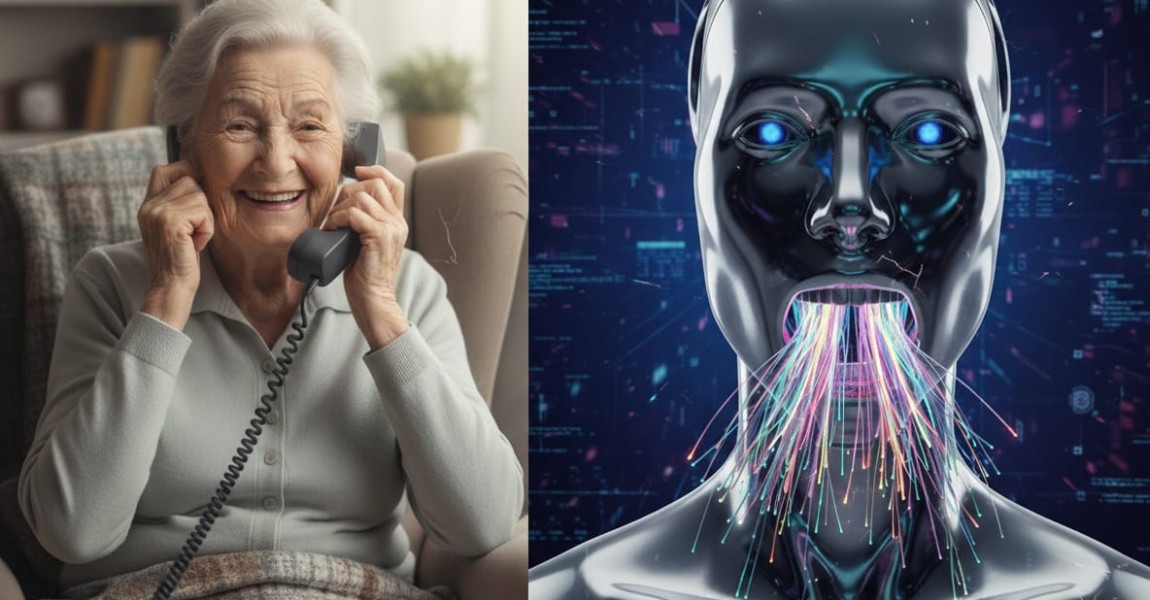
Should you let a robot chat to your gran?
At Alertacall, my own venture, one of our core values is to give older and vulnerable people the opportunity to have genuine human contact each day.
This is founded on the fact that social interaction is a fundamental human need. Our team is a friendly voice on the end of the phone (or video call) for thousands of otherwise lonely people, even if on the face of it we’re simply helping social landlords run their services more efficiently, or other health and social care organisations reduce hospital readmissions or socially prescribe.
Recently, I have been asked to sit on a board or work as an adviser for more than one enterprise involved in developing AI to have conversations with older people. They intend to deploy this technology to potentially replace the kind of genuine human contact currently provided by flesh and blood people (and which will continue to be provided by Alertacall at least).
As suspicious as I am of this trend, I fear it is a market which will begin to be exploited imminently, with ‘exploit’ being the operative word unless people like me – and maybe people like you – help shape it into something positive.
The lower cost of deploying AI rather than human operatives is bound to have an appeal to accountants both within the service providers and the organisations who they supply, such as the health, social care and housing sector.
This is a development which we need to think very hard about, with implications that go far beyond the figures on a balance sheet or the bottom line.
You are the original super computer
Despite all the hype around AI (and I am as enthusiastic about its potential as anyone) the fact remains that the human brain is the most advanced, sophisticated pattern recognition machine in the known universe.
It is a marvel of evolutionary engineering, refined over millions of years to consciously and subconsciously read and respond to its surroundings and the behaviour of other human beings. We are nowhere near fully understanding the workings of his remarkable instrument or even its full capabilities.
One of the most fascinating human traits is our capacity for unconscious processing which we call intuition; our gut feeling, not based on anything we can specifically identify, that something might be up.
Our team regularly picks up on the fact there is something “not quite right” when they are talking to customers, leading to interventions which have improved – and saved – people’s lives. Can we really expect an AI agent to do the same?
A dangerous experiment
As well as the limitations of AI versus human conversations, we also have a responsibility to consider the psychological effects.
I recently had a great discussion with the government Whip and MP for Wellingborough Gen Kitchen, in which we discussed some of the risks of AI chatbots. These include the number of young people developing mental health problems exacerbated by reductive, circular conversations with machines encouraging sometimes dangerous behaviour.
Should we allow highly convincing, unregulated conversational AI to be unleashed en masse on a vulnerable segment of the population?
How can we tell what the effects will be on older people, who are probably the most unfamiliar with this type of technology? What will the impact be on those already living with dementia or other age-related conditions?
Do we think it’s a good idea to conduct a huge, uncontrolled social experiment without thinking about it very carefully first? I can tell you, as someone who has worked in this sector for over 30 years, that it most definitely is not.
Society is currently struggling to deal with a whole range of issues linked to the dissemination of smartphones and social media on young people. The news is full of stories of governments around the world trying to impose age limits or bans in schools. The corrosive and damaging effect they can have on the minds of children is becoming abundantly clear.
Did none of us see this coming? Or were we enchanted by the shiny newness, the convenience, the money making potential and the hype to the extent that we jumped in with both feet without asking too many questions?
The story has parallels with the ancient Romans who, possessed by the gleaming utility of lead, used it to make goblets for drinking wine and subsequently experienced acute lead poisoning. No matter how shiny, convenient and fashionable something is, it can still be extremely bad for us.
Do we want to begin serving up one of humanity’s defining characteristics, the capability to converse and tell stories, in what could be the potentially poisoned chalice of AI?
As a confirmed techo-evangelist, I still firmly suggest a much better approach is to use the growing power of this technology to augment, not replace, the remarkable skillset we humans possess. We must surely, at least find a blended approach?
I can certainly see, for example, a role for machines to monitor and review conversations with older people to identify anything human agents may have missed. But let’s use digital technology to deliver more of these conversations, not less.
Surely now is the time to begin investing more in people, and making the most of their innate emotional intelligence rather than throwing it out in favour of the artificial alternative.
My final thought for today is this; is there a role to play for conversational AIs to speak to people who would otherwise have no contact?
There’s no doubt that a gulp of water from a lead lined pipe might quench a desperate thirst, irrespective of the long term toxicity.
Or is it an act of unforgivable laziness that at the height of a communications revolution, we still haven’t quite yet got our act together to connect the most isolated amongst us with other real human beings?