- 12 October 2025
- |Leadership, TLC, Uncategorized
We all have subjects that we just do not want to talk about.
Each of us has questions about ourselves, our businesses, or life in general, which we would prefer to remain unasked; those issues which are just too difficult, awkward or painful to discuss.
Broaching these taboos with people is far from easy and, if like me, you have tried, you may well have been told to get stuffed – or worse!
This blog is about how breaking taboos can be vital for finding a solution to the toughest problems. Yes, it may be hard, but experience has taught me that hard things are often those which are most worth doing.
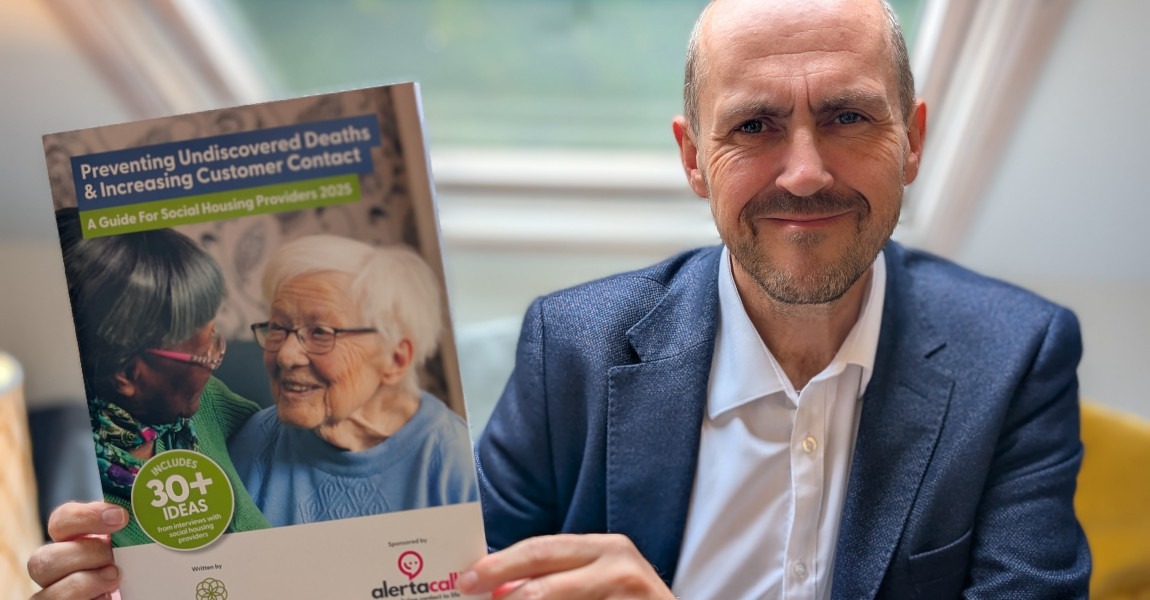
If you want to skip the blog and just get straight in to requesting a copy of my latest guide Preventing Undiscovered Deaths and Increasing Customer Contact – then click here.
Getting stuffed
I have been told to ‘get stuffed’ by people a few times.
However, there are two occasions which have altered the course of my life.
The first is when my grandmother Eveline literally told me to ‘get stuffed’ when I suggested, at the age of 86, that she might want to start carrying a personal alarm. Ultimately, it was her strong rejection of this idea which led me to invent something to help her and found Alertacall over 20 years ago.
The second was when I first tried raising the issue of undiscovered tenant deaths with the housing sector in the early days of the company. I was, in effect, told to go and ‘get stuffed’ again, albeit on a wider scale and in a more polite manner.
What I have realised is that, in both cases, I had come up against taboos, which people were very uncomfortable talking about. As is so often the case, their first reaction was quite sensitive. After all, treating an injury can be painful, even if it helps in the long run.
Before we talk about these specific issues – let’s look at three of the common features of taboo subjects.
1. The subject is emotionally difficult
We don’t like talking about it, perhaps because we worry that it will expose our own shortcomings or make someone else feel like they have failed.
2. Something else is always more important
It seems like there are more pressing issues to deal with. Sometimes this is an excuse to avoid taking action, although it can be totally genuine.
3. There is no obvious answer to the problem
The solution seems so distant that we don’t even try to reach a consensus on what to do.
In short, taboo subjects are too hard, too uncomfortable and too easy for us to brush under the carpet.
The problem is that they risk building up to the point where we – or someone else – comes and trips over them later. In social housing, this can all too often be an older or vulnerable person, sometimes with disastrous consequences.
Breaking taboos
So why did Eveline tell me to get stuffed all those years ago?
In short (and I appreciate regular readers may have heard this story before), I wanted to find a way to ensure she was safe while still enabling her to live at home independently.
My idea that she could begin carrying an alarm was given such short shrift because it was breaking a taboo – namely openly discussing the uncomfortable truth that my gran was becoming more vulnerable and less able to look after herself. To her, the alarm was a symbol of weakness, dependence and severely dented pride.
I soon realised that she was far from alone.
In fact, the vast majority of personal alarms for older people spend most of their time gathering dust on mantelpieces and in bedside cupboards. Even if people do wear them, they are often unable to trigger them when they are most in need, due to being unconscious or otherwise incapacitated or confused.
This issue is itself another taboo in a world where a huge telecare industry has been built up around portable or pull cord alarms, which – although they can have some value – are generally far less effective than is claimed.
My solution for Eveline was to invent a device with a button which she could press each day to let me know she was OK – yes, I invented the ‘I am okay’ button.
She didn’t have to wear anything or have anyone ‘checking up on her’ and it increased her independence rather than reducing it.
Eveline was customer number one for my new business, Alertacall. We now have tens of thousands of older and vulnerable customers who use our own special OKEachDay button across the UK.
It was through this work that I soon discovered another taboo – this time one which applies to the whole of society.
Turning a blind eye to a serious problem
As Alertacall evolved, we began supplying our services to people living in the social housing sector.
This led me to personally visit well over 1,000 older people to install devices in their homes.
I have written before about how this was one of the most eye-opening and shocking experiences of my life for many reasons. Above all, it revealed to me how many people live in a state of chronic isolation and loneliness.
These were residents in housing associations in busy, well-connected cities in one of the richest countries in the world – yet so many of them were having barely any regular contact from other human beings.
What’s more, they routinely told me stories of nearby properties where neighbours had died and only been discovered after days or even weeks. The shock was so profound, that I resolved to make it my mission to try and do something about it.
I began raising the issue with the people I worked with in the social housing sector. I even set up a website in an attempt to raise awareness and gather ideas for solutions.
The response was overwhelming denial.
Barely anyone wanted to talk about it. Housing providers would not acknowledge it. The website got no traction whatsoever.
Despite our rapidly ageing population, despite the number of people who die and are left undiscovered (which we estimate to number in their hundreds every year) and despite all the associated problems which could be solved by tackling the issue, it was just too tough, too painful and too shameful for people to face up to.
Getting it out in the open
The issue has not gone away over the last 20 years. If anything, there are many reasons to believe it has become more serious and, at Alertacall, we have kept it firmly in our sights.
We have been helped in this mission by some high profile friends. These include Dame Esther Rantzen, well-known celebrity TV presenter and campaigner for the rights of older people, and Sir Norman Lamb, former MP and Minister for Care and Support.
Most importantly, we have insistently reminded housing providers that coming up with effective methods for reducing the number of undiscovered tenant deaths has myriad other benefits, for resources, for budgets, for staff morale and – crucially – for the lives of residents.
At the beginning of this year I circulated a guide, which discussed some approaches to tackling the issue, to every housing provider in the UK. This was, in part, an appeal to the sector to enter a dialogue with me about practices they can adopt to help alleviate the problem.
This time the response was overwhelming again – but in a far more positive way.
I must admit, given my experience of 20 years ago, I was fully prepared to be told to ‘get stuffed’. Instead, I had over 200 responses leading to more than 50 meetings with housing providers.
The result is a follow-up guide detailing over 30 practical ideas which has been released this month and which you can download below.
Download the guide now
So what has changed?
There are a number of factors which have helped the housing sector break the taboo on undiscovered deaths.
Laws and regulations – Tragedies such as the Grenfell Fire disaster, and the death of two-year-old Awaab Ishak after being exposed to damp and mould in a social housing flat have led to new measures requiring providers to maintain regular two-way contact with residents.
High profile cases – A number of high profile cases have gained significant press attention. These include the story of Sheila Seleoane, who lay undiscovered in her social housing flat in London for two years. There was also the desperately sad tale of baby Harry Kane, in Cumbria, who was found dead after his mother Natalie died and they were both left undiscovered for a number of days.
The impact of the pandemic – During the Covid-19 lockdowns we were all forced to face the reality of social isolation, as well as spending more time interacting with and simply noticing our neighbours. This has helped bring the issue to wider attention.
Hope for the future
I can honestly say that the process of meeting with housing providers and putting together the new guide has been a delight.
In contrast to my experience of 20 years ago, I have found people to be full of empathy, incredibly generous with their time and brimming with ideas to help.
Some people came to the meetings worried that they did not have enough to contribute. However, just talking things through often revealed they were already taking action – even if they did not quite realise it – and had useful suggestions to share.
Something new and valuable came out of every single conversation. I cannot think of a better example of the power of overcoming taboos.
The most encouraging aspect of the process is that housing providers not only acknowledged the role they could play but also the size of the opportunity it represents. There was an overriding realisation that practices for reducing undiscovered deaths would have compounding benefits across their organisations.
This is far from the end of the process.
Over the coming year I am going to begin sharing the latest version of the guide with MPs, community groups and others who can help reduce undiscovered deaths and improve people’s lives.
I invite everyone to download and read the guide and, please, get in touch with me if you have anything you would like to contribute or discuss.
It is my hope that we can grow this into a movement which will have a tangible, long-lasting impact – not just for those elderly and vulnerable people who live alone – but for society as a whole.
Because finding ways to care for each other inevitably helps us all.
Please download and read the guide here and get in touch with any ideas or comments.